Pay After Placement Bootcamps in India (2026): What You Actually Pay
By Deepak Sharma. Published .
Topics: Bootcamp Comparison, coding, free bootcamps, b
Quick answer
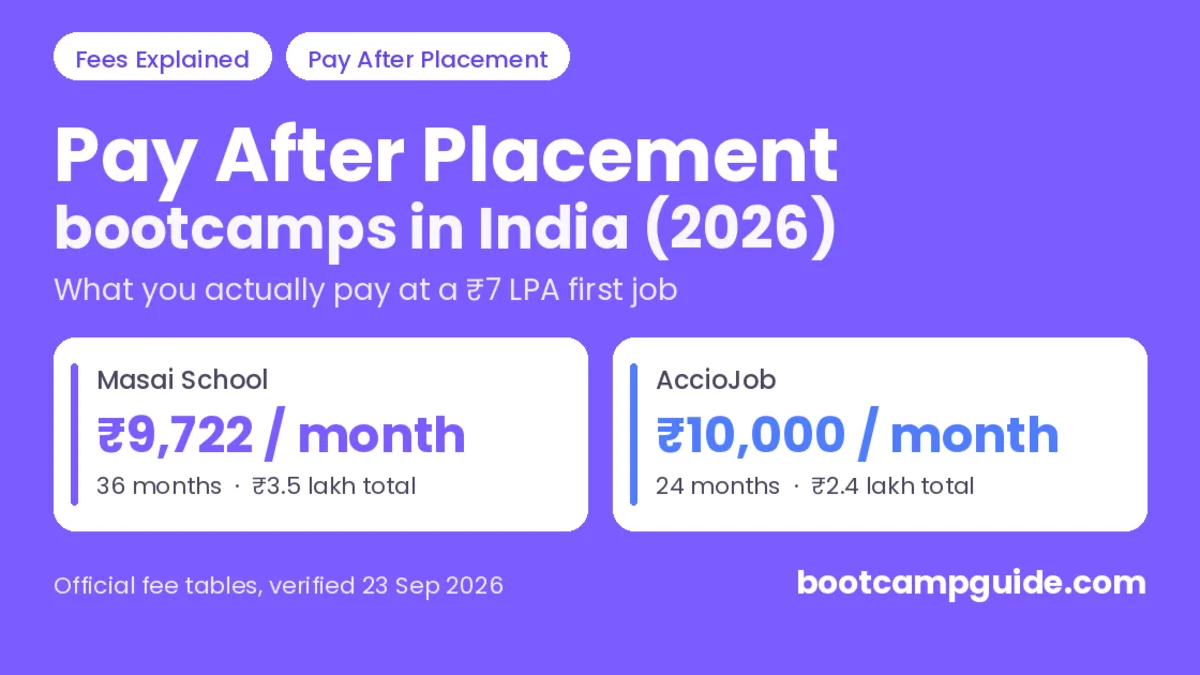
"Pay After Placement" (PAP) means you pay ₹0 or a small deposit upfront and owe the course fee only after you land a job above a salary threshold. The fee is not small: at the two schools that publish full terms, you owe ₹2.5 to ₹4.5 lakh at Masai School (threshold ₹3.5 LPA, 30 to 36 monthly payments) and ₹1.8 to ₹4 lakh at AccioJob (threshold ₹3 LPA, up to 24 monthly payments). At a ₹7 LPA first job, that works out to roughly ₹10,000 a month, or about 17% of your gross salary, for two to three years.
PAP is worth it if you cannot fund ₹1.5 to ₹4 lakh upfront and you want the school to carry the risk of you not getting placed. It is a bad deal if you are likely to land a ₹10 LPA+ role anyway, because the higher slabs cost more than paying upfront would have. Everything below explains why.
What "Pay After Placement" actually means
Three different things get sold under the same label in India. Ask which one you are signing.
1. A deferred fee with salary slabs. The school sets a fixed total fee that depends on your CTC band, and you repay it in monthly instalments with no interest. This is what Masai School and AccioJob run. Your total is capped and known in advance.
2. An Income Share Agreement (ISA). You agree to pay a fixed percentage of your monthly income for a fixed number of months, usually with a cap. Your total depends on what you earn. AlmaBetter and Sharpener Tech describe their models as ISAs. Some schools use "PAP" and "ISA" interchangeably, so read the clause, not the label.
3. A loan wearing a PAP badge. Some counsellors offer "pay later" through a lending partner. That is an NBFC loan with an interest rate and an EMI that starts on a date, not on a job. It is a different product with different risks. Check the lender against the RBI's list of registered NBFCs before you sign anything.
India has no specific regulatory framework for income share agreements; they are private contracts under ordinary contract law, and unlike an education loan they carry no tax deduction on repayments (WeMakeScholars). That does not make them bad. It means the agreement document is the only protection you have.
The terms that decide what you owe
Every PAP agreement is really eight numbers and definitions. Get all eight in writing before you enrol.
| Term | What to ask | Why it matters |
|---|---|---|
| Threshold CTC | Below what salary do I pay nothing? | Masai ₹3.5 LPA, AccioJob ₹3 LPA, AlmaBetter ₹6 LPA |
| Fee slabs or share % | What do I owe at ₹4, ₹7, ₹12 LPA? | Slabs jump sharply at band edges |
| Tenure | How many monthly payments? | 24 vs 36 months changes the monthly bite |
| Placement window | How long after course completion does the obligation last? | Masai waives the fee if you are not placed within 1 year |
| Definition of "placement" | Does a job I find myself count? Does an internship or contract role count? | Some agreements trigger on any job above threshold, not just school-referred ones |
| Definition of CTC | Is variable pay, joining bonus, ESOP included? | Masai counts "total gross income, including variable pay, compensations and ESOPs" |
| Pause clause | What happens if I lose the job or my salary drops? | Payments should pause, not accrue |
| Drop-out clause | What do I owe if I leave in week 4, week 12, week 30? | Leaving late can cost the full fee |
School by school: the published PAP terms
Only two schools publish complete fee tables on a public page. The rest disclose terms at the agreement stage.
Masai School
Masai's PAP page is the most transparent in the category. ₹0 upfront. Payments start only if your CTC crosses ₹3,50,000. If you do not get an offer within one year of course completion, the course is free. Masai states the agreement is not a loan, charges no interest and needs no collateral. Payments pause if you are not working or your income drops below the threshold.
| Your CTC | Monthly payment | Months | Total you pay |
|---|---|---|---|
| Below ₹3.5 LPA | ₹0 | NA | ₹0 |
| ₹3.5 to ₹4.99 LPA | ₹6,944 | 36 | ₹2,50,000 |
| ₹5 to ₹9.99 LPA | ₹9,722 | 36 | ₹3,50,000 |
| ₹10 LPA and above | ₹15,000 | 30 | ₹4,50,000 |
Source: masaischool.com/fees. Masai also publishes a drop-out fee table; what you owe depends on how far into the course you leave, so check the current slab before enrolling. Older articles still quote a ₹5 LPA threshold. The official page now says ₹3.5 LPA.
AccioJob
AccioJob offers PAP on a limited number of seats to students who clear its assignment, coding test and interview. Everyone else pays a reduced upfront fee. Under PAP, you pay ₹0 upfront and the school states you owe nothing if placed below ₹3 LPA.
| Your CTC | Total you pay | Tenure |
|---|---|---|
| Below ₹3 LPA | ₹0 | NA |
| ₹3 to ₹5 LPA | ₹1,80,000 | Up to 24 months |
| ₹5 to ₹10 LPA | ₹2,40,000 | Up to 24 months |
| ₹10 to ₹20 LPA | ₹3,00,000 | Up to 24 months |
| ₹20 LPA and above | ₹4,00,000 | Up to 24 months |
Source: acciojob.com/pay-after-placement. Two clauses to note. First, AccioJob's page says placement services must start immediately after course completion, so you cannot finish, take a gap and then use the placement team later. Second, the alternative "upfront" plan is a hybrid: ₹75,000 paid over 12 months during the course, with a remaining fee after placement. Ask what that remaining fee is.
AlmaBetter
AlmaBetter charges tuition only when you get a job in the relevant domain above ₹6 LPA, or a hike of more than 25% on your current salary. Its FAQ says the ISA legally binds you to furnish income documents such as offer letters, salary slips, income tax returns and bank statements. The share percentage and cap are not published on the public FAQ, so ask for the full ISA before you accept. Source: AlmaBetter LER explained.
Sharpener Tech
Sharpener runs a security-deposit model: you pay a refundable deposit to reserve a seat, complete the course, sign an ISA, then start paying after placement. The deposit is described as adjustable against your ISA terms. The threshold and share are disclosed at signing, not on the public page. Source: sharpener.tech/pay-after-placement.
Newton School
Newton School built its name on PAP with a ₹5 to ₹6 LPA threshold, but its current full-stack course page no longer publishes a PAP table or a fee. Treat any PAP offer from a Newton counsellor as unverified until you have it in the agreement document, and check whether the "pay later" option is a lending partner's EMI product.
Scaler Academy
Scaler does not run PAP. The fee is ₹3.99 lakh upfront or on EMI. If you are deciding between a deferred-fee school and a pay-upfront school, our Scaler Academy vs Masai School comparison walks through the maths at every salary level.
What PAP costs at your salary
Schools advertise "₹0 upfront." The number that matters is the monthly payment as a share of your gross salary, because that is what leaves your account for two to three years. Here is the like-for-like view for the two schools with published tables.
| First-job CTC | Gross per month | Masai monthly (tenure) | Masai as % of gross | AccioJob monthly (tenure) | AccioJob as % of gross |
|---|---|---|---|---|---|
| ₹4 LPA | ₹33,333 | ₹6,944 (36) | 20.8% | ₹7,500 (24) | 22.5% |
| ₹7 LPA | ₹58,333 | ₹9,722 (36) | 16.7% | ₹10,000 (24) | 17.1% |
| ₹12 LPA | ₹1,00,000 | ₹15,000 (30) | 15.0% | ₹12,500 (24) | 12.5% |
| ₹25 LPA | ₹2,08,333 | ₹15,000 (30) | 7.2% | ₹16,667 (24) | 8.0% |
AccioJob monthly figures assume the full 24-month tenure; its page says "up to 24 months", so shorter tenures mean higher monthly amounts. Percentages are on gross CTC. Your in-hand salary after PF, tax and deductions is lower, so the real bite on take-home pay is higher, often 20 to 25% at the ₹4 to ₹7 LPA level.
Three things fall out of this table.
At ₹4 LPA, PAP is expensive. You are giving up a fifth of your gross salary for two to three years on a job that barely clears the threshold. This is the scenario to plan for, because a ₹4 LPA first offer is common for freshers from non-CS backgrounds.
Slab edges are cliffs. At Masai, a ₹9.9 LPA offer costs ₹3.5 lakh total; a ₹10 LPA offer costs ₹4.5 lakh. That ₹10,000 raise costs you ₹1 lakh. Negotiate with the slab in mind, or ask whether joining bonus and variable pay are counted in the CTC used for slab assignment (at Masai, they are).
Higher earners pay for the risk pool. A ₹12 LPA Masai graduate pays ₹4.5 lakh for a course that a ₹4 LPA graduate gets for ₹2.5 lakh and an unplaced graduate gets free. That is how PAP works: it is insurance, not a discount. If you are confident of a ₹10 LPA+ outcome, the upfront route is usually cheaper.
PAP vs an education loan: the honest maths
A ₹3.5 lakh education loan at 12% over 36 months is an EMI of roughly ₹11,600 and a total repayment of about ₹4.18 lakh. Masai's ₹5 to ₹9.99 LPA slab is ₹9,722 a month and ₹3.5 lakh total for the same period, with no interest and no payment if you are unplaced. On that comparison, PAP wins clearly.
The comparison flips when your salary rises. A loan's EMI does not increase when you get a ₹12 LPA offer; Masai's slab does. And a loan repayment on a recognised course can qualify for a deduction on interest under Section 80E, which an ISA payment does not. Run both numbers against your realistic salary band, not the school's "highest package."
Eight questions to ask before you sign
- Can I see the full agreement before I accept the seat? Masai's FAQ has a "Can I see a copy of the PAP Agreement?" entry. Any school that refuses to show the document before enrolment is telling you something.
- Who is the counterparty? The school, or a lending partner? If a lender, get its name and check the RBI NBFC register.
- What exactly triggers payment? Any job above threshold, or only a job through the school's placement cell? What about contract roles, internships that convert, or a job you found yourself?
- What counts as CTC? Fixed only, or fixed plus variable, bonus and ESOP? This decides your slab.
- What happens if I lose the job in month 4? Look for a written pause clause, not a verbal reassurance.
- What do I owe if I drop out? Get the week-by-week table.
- How long does placement support actually last, and what am I required to do to keep it? Some agreements require minimum application counts or attendance to stay eligible for the fee waiver.
- What are the actual placement numbers for my profile? Ask for median CTC and placement rate for the last three cohorts, split by fresher vs experienced. In 2024 the US consumer regulator found a major bootcamp had advertised placement rates of up to 86% while its internal data showed closer to 50%, and that its "not a loan" ISAs were loans with an average finance charge of around $4,000 (CFPB order against BloomTech). India has no equivalent regulator for this category, so the diligence is yours.
Who should choose PAP, and who should not
Choose PAP if you cannot pay ₹1.5 to ₹4 lakh upfront, you are a fresher or a non-CS graduate whose realistic first offer is in the ₹3.5 to ₹8 LPA band, and you value the school carrying the risk of no placement. At those salaries, the deferred fee is cheaper than a loan and far safer than paying upfront and not getting placed.
Pay upfront instead if you already work in tech, your realistic outcome is ₹10 LPA or more, or you can fund the fee from savings or family without debt. At ₹12 LPA, Masai's PAP costs ₹4.5 lakh; Scaler's upfront fee is ₹3.99 lakh; a self-funded ₹3.5 lakh Masai fee would have been ₹1 lakh cheaper than the PAP slab.
Skip both if you have not yet written a few hundred lines of code on your own. Read why (and whether) to enrol in a coding bootcamp first, spend a month on free material, and only then sign a two-to-three-year financial commitment.
Sources and how we checked
Fee tables and thresholds were read directly from each school's official page on 23 September 2026: Masai School fees, AccioJob Pay After Placement, AlmaBetter ISA FAQ, Sharpener Tech PAP, and Newton School's full-stack course page. Percentages are simple arithmetic on gross CTC. Loan EMI uses a standard amortisation formula at 12% over 36 months. Regulatory context is from the RBI NBFC register and the CFPB's 2024 BloomTech order. Schools change terms without notice; if you spot a discrepancy, the official page wins and we will update this article.
BootcampGuide has no commercial relationship with any school named here.