CFA Level 1 Syllabus 2027: Topics, Weights, PDF | BootcampGuide
 By Deepak Sharma, Marketing Manager at BootcampGuide and Content Lead at TestMu AI.
B2B SaaS content strategist, certified in Selenium, Cypress, Playwright, Appium, Automation Testing and KaneAI. Published . 14 min read. Human edited.
Topics: CFA, Syllabus, Finance and Accounting, India, Original Research
By Deepak Sharma, BootcampGuide. Every topic weight, module name, exam rule and date below was read from CFA Institute's own pages and its 2027 Level I topic outline on 26 November 2026. Question counts and study-hour splits are our own arithmetic from those weights, and are labelled as such. See sources.
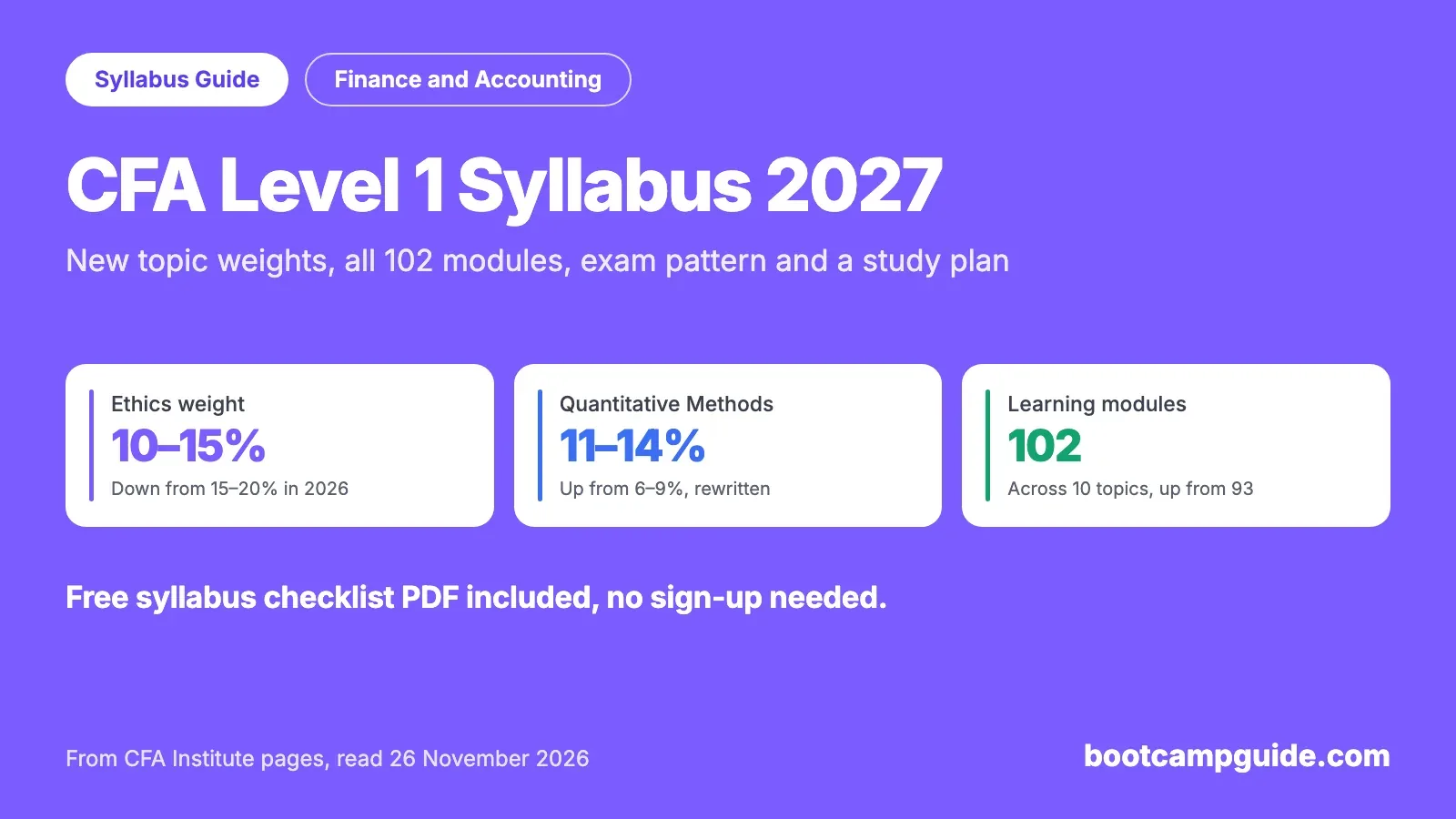
The CFA Level 1 syllabus has 10 topics and 102 learning modules for exams from February 2027, and the topic weights have changed. Ethics drops from 15–20% of the exam to 10–15%, Quantitative Methods rises from 6–9% to 11–14%, and three topics are renamed: Corporate Issuers is now Corporate Finance, Equity Investments is now Equities, and Portfolio Management is now Portfolio Construction. CFA Institute says the updates represent about 25% of the Level I exam.
Several of the most-read CFA Level 1 syllabus pages still show the 2026 weights and still call Ethics the heaviest topic, which is no longer true for anyone sitting from February 2027. Below are the official 2027 weights, every learning module by topic, the exam pattern, what changed, how to plan 300 hours of study, and what Indian candidates need to know about fees, exam centres and eligibility. A free syllabus checklist PDF with every module is included, with no sign-up needed.
Key takeaway: four topics now carry 11–14% each (Quantitative Methods, Financial Statement Analysis, Equities and Fixed Income) and Ethics 10–15%. Together these five make up at least 54% of the exam. Fixed Income has the most modules (19), so it needs the most study time per percentage point.
CFA Level 1 syllabus 2027: topics and weights
| Session | Topic (2027 name) | 2027 weight | Approx. questions of 180 | Modules | 2026 weight |
|---|---|---|---|---|---|
| 1 | Ethical and Professional Standards | 10-15% | 18 to 27 | 10 | 15-20% |
| 1 | Quantitative Methods | 11-14% | 20 to 25 | 11 | 6-9% |
| 1 | Economics | 6-9% | 11 to 16 | 8 | 6-9% |
| 1 | Financial Statement Analysis | 11-14% | 20 to 25 | 12 | 11-14% |
| 1 | Corporate Finance (was Corporate Issuers) | 6-9% | 11 to 16 | 7 | 6-9% |
| 2 | Equities (was Equity Investments) | 11-14% | 20 to 25 | 12 | 11-14% |
| 2 | Fixed Income | 11-14% | 20 to 25 | 19 | 11-14% |
| 2 | Derivatives and Risk Management (was Derivatives) | 6-9% | 11 to 16 | 10 | 5-8% |
| 2 | Alternative Investments | 6-9% | 11 to 16 | 7 | 7-10% |
| 2 | Portfolio Construction (was Portfolio Management) | 8-12% | 14 to 22 | 6 | 8-12% |
Weights are CFA Institute's official ranges for the 2027 exams. Question counts are our arithmetic: 180 questions multiplied by each weight range, so a topic weighted 11–14% means roughly 20 to 25 questions. Sessions are CFA Institute's split: session 1 covers the first five topics and session 2 the last five.
What changed in the CFA Level 1 syllabus for 2027
- Quantitative Methods was rewritten and now weighs 11–14%, nearly double. All 11 modules are new, covering returns, benchmarking, time value of money, distributions, estimation and hypothesis testing, portfolio risk and return, simulation, regression, and a new "Introduction to Financial Data Science" on how big data, machine learning and AI are used in investment management.
- Equities was rebuilt. Its 12 modules now emphasise valuation, forecasting, analyst research reports, cost of equity and factor-based models, replacing older modules on market organisation, indexes and market efficiency.
- Ethics fell to 10–15% but has more modules. The Standards are now split into seven modules, one per Standard, and the GIPS module has been dropped from the 2027 outline.
- Three topics were renamed: Corporate Finance, Equities and Portfolio Construction. Derivatives became "Derivatives and Risk Management" and rose to 6–9%; Alternative Investments dipped to 6–9%.
- The other topics kept the same modules. Economics, Financial Statement Analysis, Corporate Finance, Fixed Income, Derivatives, Alternatives and Portfolio Construction have the same module names as in 2026. In all, the outline grew from 93 modules in 2026 to 102.
If you are using 2026 study material for a 2027 exam, the Quant, Equities and Ethics sections are the ones to replace.
CFA Level 1 subjects: all 102 learning modules
Module names are as published in CFA Institute's 2027 Level I topic outline, in its order. Each module begins with learning outcome statements (LOS) that define what can be tested; read them in the official outline linked in our sources.
Ethical and Professional Standards (10-15%, 10 modules)
- Ethics and Trust in the Investment Profession
- Code of Ethics and Standards of Professional Conduct
- Guidance for Standard I: Professionalism
- Guidance for Standard II: Integrity of Capital Markets
- Guidance for Standard III: Duties to Clients
- Guidance for Standard IV: Duties to Employers
- Guidance for Standard V: Investment Analysis, Recommendations, and Actions
- Guidance for Standard VI: Conflicts of Interest
- Guidance for Standard VII: Responsibilities as a CFA Institute Member or CFA Candidate
- Application of the Code and Standards: Level I
Quantitative Methods (11-14%, 11 modules)
- Returns of Financial Assets and Instruments
- Types of Financial Returns
- Benchmarking Returns
- The Time Value of Money in Finance
- Statistical Characteristics of Asset Returns
- Statistical Distributions for Financial Asset Prices and Returns
- Estimation and Hypothesis Testing
- The Return and Risk of a Financial Portfolio
- Simulation of Financial Asset Prices and Returns
- Applications of Simple Linear Regression in Finance
- Introduction to Financial Data Science
Economics (6-9%, 8 modules)
- The Firm and Market Structures
- Understanding Business Cycles
- Fiscal Policy
- Monetary Policy
- Introduction to Geopolitics
- International Trade
- Capital Flows and the FX Market
- Exchange Rate Calculations
Financial Statement Analysis (11-14%, 12 modules)
- Introduction to Financial Statement Analysis
- Analyzing Income Statements
- Analyzing Balance Sheets
- Analyzing Statements of Cash Flows I
- Analyzing Statements of Cash Flows II
- Analysis of Inventories
- Analysis of Long-Term Assets
- Topics in Long-Term Liabilities and Equity
- Analysis of Income Taxes
- Financial Reporting Quality
- Financial Analysis Techniques
- Introduction to Financial Statement Modeling
Corporate Finance (6-9%, 7 modules)
- Organizational Forms, Corporate Issuer Features, and Ownership
- Investors and Other Stakeholders
- Corporate Governance: Conflicts, Mechanisms, Risks, and Benefits
- Working Capital and Liquidity
- Capital Investments and Capital Allocation
- Capital Structure
- Business Models
Equities (11-14%, 12 modules)
- Equity Instrument Features
- Equity Jurisdictions, Classes, and the Voting Process
- Equity Issuance and Trading
- Sources of Equity Returns
- Introduction to Equity Valuation
- Discounted Cash Flow (DCF) and Growth Models
- Relative Value Equity Valuation Approaches
- Financial Statement Forecasting in Equity Valuation
- Industry and Competitive Analysis
- Company Analysis: Past, Present, and Future
- Equity Analyst Research Reports
- The Capital Asset Pricing Model, Market Model, and Other Factor-Based Equity Models
Fixed Income (11-14%, 19 modules)
- Fixed-Income Instrument Features
- Fixed-Income Cash Flows and Types
- Fixed-Income Issuance and Trading
- Fixed-Income Markets for Corporate Issuers
- Fixed-Income Markets for Government Issuers
- Fixed-Income Bond Valuation: Prices and Yields
- Yield and Yield Spread Measures for Fixed-Rate Bonds
- Yield and Yield Spread Measures for Floating-Rate Instruments
- The Term Structure of Interest Rates: Spot, Par, and Forward Curves
- Interest Rate Risk and Return
- Yield-Based Bond Duration Measures and Properties
- Yield-Based Bond Convexity and Portfolio Properties
- Curve-Based and Empirical Fixed-Income Risk Measures
- Credit Risk
- Credit Analysis for Government Issuers
- Credit Analysis for Corporate Issuers
- Fixed-Income Securitization
- Asset-Backed Security (ABS) Instrument and Market Features
- Mortgage-Backed Security (MBS) Instrument and Market Features
Derivatives and Risk Management (6-9%, 10 modules)
- Derivative Instrument and Derivative Market Features
- Forward Commitment and Contingent Claim Features and Instruments
- Derivative Benefits, Risks, and Issuer and Investor Uses
- Arbitrage, Replication, and the Cost of Carry in Pricing Derivatives
- Pricing and Valuation of Forward Contracts and for an Underlying with Varying Maturities
- Pricing and Valuation of Futures Contracts
- Pricing and Valuation of Interest Rate and Other Swaps
- Pricing and Valuation of Options
- Option Replication Using Put–Call Parity
- Valuing a Derivative Using a One-Period Binomial Model
Alternative Investments (6-9%, 7 modules)
- Alternative Investment Features, Methods, and Structures
- Alternative Investment Performance and Returns
- Investments in Private Capital: Equity and Debt
- Real Estate and Infrastructure
- Natural Resources
- Hedge Funds
- Introduction to Digital Assets
Portfolio Construction (8-12%, 6 modules)
- Portfolio Risk and Return: Part I
- Portfolio Risk and Return: Part II
- Portfolio Management: An Overview
- Basics of Portfolio Planning and Construction
- The Behavioral Biases of Individuals
- Introduction to Risk Management
CFA Level 1 exam pattern
| Feature | CFA Level I |
|---|---|
| Questions | 180 multiple-choice questions, each with three answer choices (A, B or C) |
| Sessions | Two sessions of 135 minutes, 90 questions each |
| Time per question | About 90 seconds, as CFA Institute advises |
| Marking | All questions equally weighted; no penalty for a wrong answer |
| Break | Optional break of up to 31 minutes between sessions |
| Total time at the centre | About 5.5 hours on screen, including a 19-minute pledge and tutorial and an 8-minute survey |
| Calculators allowed | Only the Texas Instruments BA II Plus (including Professional) or the HP 12C (including Platinum, anniversary editions and Prestige) |
| Accounting standard | IFRS, unless a question says US GAAP |
| Results | Typically 5 to 7 weeks after the exam, as pass or fail with a performance summary by topic |
Questions avoid "except", "true" and "false", and instead ask which answer is "most likely", "least accurate" and so on, so read each stem carefully. Since there is no negative marking, never leave a question blank.
The Practical Skills Module you must complete
Passing the exam is not enough to get your result. CFA Institute requires one Practical Skills Module (PSM) at each level, and at Level I for 2027 you choose between Financial Modeling (building a three-statement financial model) and Python Programming Fundamentals (Python for finance in Jupyter notebooks). Each takes 10 to 20 hours.
The rule is strict: under CFA Institute's PSM policy, if you have not completed and submitted a PSM by the time results are released, your exam result is voided and you must register, pay and sit the exam again. You can start the PSM any time after registering, and you cannot reuse the same module at Level II.
How long to study for CFA Level 1, and in what order
CFA Institute says successful candidates report spending "over 300 hours on average" on each level. At 15 hours a week, that is about 20 weeks, or five months. Here is how those 300 hours split if you study each topic in proportion to its 2027 weight; it is our suggestion, not an official figure:
| Topic | Suggested hours |
|---|---|
| Ethical and Professional Standards | 37 |
| Quantitative Methods | 37 |
| Economics | 22 |
| Financial Statement Analysis | 37 |
| Corporate Finance | 22 |
| Equities | 37 |
| Fixed Income | 37 |
| Derivatives and Risk Management | 22 |
| Alternative Investments | 22 |
| Portfolio Construction | 29 |
Topics with many modules, Fixed Income above all, may need more than their weight suggests. A common order is to start with Quantitative Methods and Economics, which later topics rely on, then Financial Statement Analysis before Corporate Finance and Equities, Fixed Income and Derivatives together, then Alternatives and Portfolio Construction, finishing with Ethics close to the exam so the Standards are fresh. Leave the last three to four weeks for mock exams and revision.
CFA Level 1 for Indian candidates: fees, dates, centres, eligibility
| What you need to know | Details |
|---|---|
| Exam fee | US$1,140 at the early price, US$1,490 standard; about ₹1.05 lakh and ₹1.38 lakh at the RBI reference rate of 25 November 2026. There is no separate enrolment fee from 2026. |
| 2027 exam windows | February (22 to 28 Feb), May (11 to 17 May), August (15 to 22 Aug) and November (13 to 19 Nov 2027) |
| Next deadlines | May 2027: registration closes 10 February 2027, standard price only. August 2027: early price until 20 January 2027, registration closes 29 April 2027. |
| Eligibility | A bachelor's degree, or an undergraduate whose Level I window is 23 months or less before graduation, or 4,000 hours of work and higher education over at least three years. Paid internships and articleships count as work experience. |
| Passport | A valid international travel passport is required to register and sit the exam. |
| Exam centres in India | 30 cities on CFA Institute's list: Ahmedabad, Bengaluru, Bhopal, Bhubaneswar, Chandigarh, Chennai, Coimbatore, Dehradun, Guwahati, Gurugram, Hyderabad, Indore, Jaipur, Jodhpur, Kochi, Kolkata, Lucknow, Manipal, Mumbai, Nagpur, Nashik, New Delhi, Noida, Pune, Raipur, Rajkot, Ranchi, Surat, Thane (from February 2027) and Visakhapatnam |
Indian commerce students start with an advantage in some topics: B.Com and CA students will recognise much of Financial Statement Analysis and Corporate Finance, though the exam uses IFRS. Our CFA course fees guide adds up the full cost of all three levels, and our guide to the best CFA coaching in India compares preparation providers.
Is CFA Level 1 very difficult?
It is hard to pass, though not because any single topic is advanced. The difficulty is breadth: 102 modules across ten topics in one sitting. Fewer than half of candidates pass. In 2026, the Level I pass rate was 45% in February, 39% in May and 43% in August, and CFA Institute's 10-year average (2017 to 2026) is 40%. Candidates who defer their exam do worse: CFA Institute reported a 50% pass rate for first-time candidates in one 2026 window, against 30% for those testing after a deferral.
Is CFA harder than an MBA? They are hard in different ways. The CFA is a set of three exams, each needing over 300 hours of study and each passed by fewer than half of candidates, which you can take while working. An MBA is a full-time or executive degree where the main hurdle is admission. The CFA goes deeper into investment analysis; an MBA is broader across management. Many finance professionals take both.
What is the CFA Level 1 salary?
Passing Level I does not set a salary on its own, but it helps you get investment roles. CFA Institute's 2026 India study, run with Kantar, found working Level I candidates average ₹14.6 lakh a year, with about 3.7 years of experience. Freshers who have passed Level I typically earn what their first role pays, from about ₹3.5 lakh to ₹7 lakh as a research, financial or investment analyst. Our CFA salary guide has pay by level, role and city.
CFA syllabus for all three levels
| Topic | Level I | Level II | Level III |
|---|---|---|---|
| Ethical and Professional Standards | 10-15% | 10-15% | 10-15% |
| Quantitative Methods | 11-14% | 5-10% | - |
| Economics | 6-9% | 5-10% | - |
| Financial Statement Analysis | 11-14% | 10-15% | - |
| Corporate Finance | 6-9% | 5-10% | - |
| Equities | 11-14% | 10-15% | - |
| Fixed Income | 11-14% | 10-15% | - |
| Derivatives and Risk Management | 6-9% | 5-10% | 10-15% |
| Alternative Investments | 6-9% | 5-10% | - |
| Portfolio Construction | 8-12% | 10-15% | 15-20% |
| Asset Allocation | - | - | 15-20% |
| Performance Measurement | - | - | 5-10% |
| Pathway (Portfolio Management, Private Markets or Private Wealth) | - | - | 30-35% |
Level II has 22 item sets (vignettes) with 88 multiple-choice questions over two sessions of 132 minutes. Level III has 11 item sets and 11 essay sets over two sessions of 132 minutes, and candidates choose one of three pathways. The full CFA Program takes three to four years, at about 300 hours of study per level.
How to prepare for CFA Level 1
- Use 2027 material if you sit from February 2027. The Quant, Equities and Ethics changes make 2026 notes incomplete.
- Register early. The early price saves US$350 (about ₹32,000), and centres fill on a first-come, first-served basis.
- Buy and learn an approved calculator now. Only the BA II Plus and HP 12C families are allowed.
- Finish your PSM early. It takes 10 to 20 hours, and missing it voids your result.
- Practise under exam conditions. Time yourself at 90 seconds a question and sit full mock exams in the last month.
Compare CFA coaching and classes in the BootcampGuide course listing, or download the 2027 syllabus checklist to track every module.
Sources and how we checked
All pages and documents were read on 26 November 2026. Where CFA Institute's own pages disagreed, we followed the most specific document: the 2027 topic outline for module names, and the Level I exam page for topic names and weights.
- CFA Institute: Level I exam (2027 and 2026 weights, format, study hours); 2027 Level I topic outlines and 2026 outlines; press release, updates to the CFA Program curriculum, 26 May 2026.
- CFA Institute rules: Practical Skills Modules and PSM policy; calculator policy; exam-day guide; eligibility policies.
- Dates, fees and centres: CFA exam dates and fees; test center locations and the official list of test centres.
- Other levels: CFA Institute Level II exam and Level III exam pages; CFA Program overview.
- Pass rates: CFA Institute, CFA exam results 1963 to 2026.
- Exchange rate from the MSEI archive of RBI reference rates, 25 November 2026. Salary figures from our CFA salary guide, which cites CFA Institute and Kantar's 2026 India study.