Coding Bootcamp vs Degree in India: Which Should You Choose? (2026)
 By Deepak Sharma.
Published . 5 min read
Topics: Bootcamp Basics, Coding Bootcamps, Degree, India, Bootcamp Comparison
By Deepak Sharma, BootcampGuide. Bootcamp figures are from the 87 live programmes listed on this site on 24 October 2026; recognition facts are from the regulators' own sites. See sources.
Quick answer
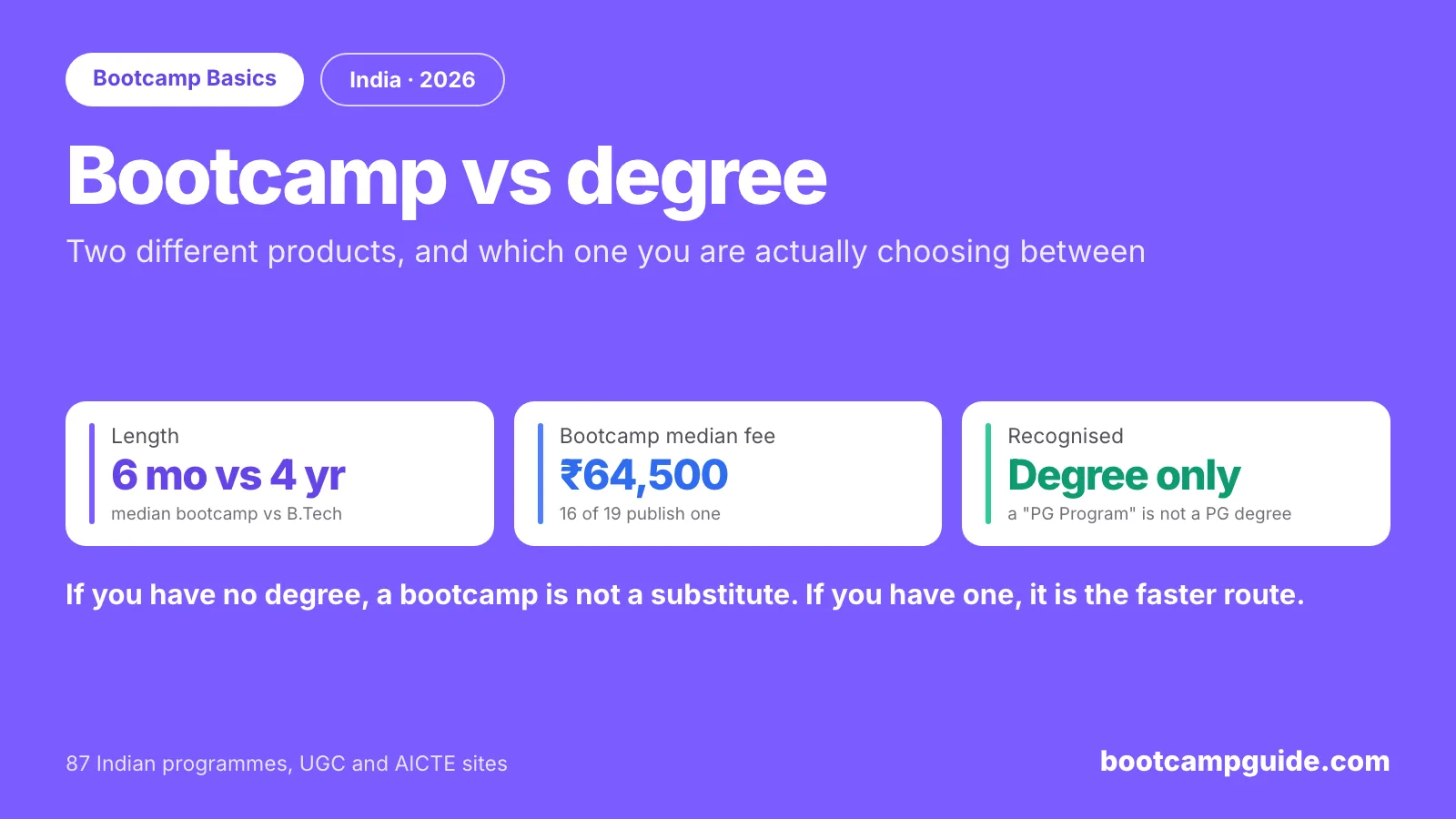
A degree is a recognised qualification that takes four years. A coding bootcamp is a six-month job-preparation programme that is not a qualification at all. If you are 18 and choosing what to do after school, the degree is the default and a bootcamp is not a substitute for it. If you already have a degree in anything and want a software job, a bootcamp is the faster route and the degree you have is the one employers will see.
The comparison most people are actually making is not bootcamp versus degree; it is bootcamp after degree versus master's after degree versus self-study after degree. On that question the numbers below are what matter.
What each one is
| Engineering degree (B.Tech / BE) | Coding bootcamp | |
|---|---|---|
| Length | Four years | Median 6 months across 87 Indian programmes; coding ones from 12 weeks to 20 months |
| What you hold at the end | A degree recognised by the UGC, from an institution approved by AICTE | A certificate from a private company. Not a UGC qualification, whatever it is called |
| Fee | Set by the institution; published in its own fee circular | Median ₹64,500 for coding programmes; 16 of 19 publish a fee |
| Taught | Computer science as a discipline: mathematics, theory, systems, electives | One job, end to end: usually full stack or backend, plus interview preparation |
| Admission | Entrance examination and rank | Most accept any background; some run an entrance test |
| Placement | Campus placement cell; outcomes published by the institution and reported to NIRF | "Placement assistance" claimed by all 19 coding programmes we list; none publishes an audited rate |
| Further study | Qualifies you for a master's, for government posts that require a degree, and for employers abroad | Qualifies you for nothing that asks for a qualification |
"PG Program", "Fellowship", "IIT certification": what the names mean
This is where people get caught. A "Postgraduate Program in Data Science" from a private institute is not a postgraduate qualification. A "Fellowship in Software Engineering with IIT Patna" is not admission to IIT Patna. In our listings the IIT co-brands resolve to one of three real but non-degree things: an E&ICT Academy (a government-funded skilling body hosted at an IIT — IIT Roorkee's is one), a Technology Innovation Hub such as IITM Pravartak, or a vendor certification track from IBM or Microsoft. All three are legitimate. None is a degree, and none changes what the bootcamp is.
If any part of your plan depends on the credential itself — a visa category, a government job, a master's abroad, an employer that lists "B.Tech/BE" as a requirement — the bootcamp certificate will not do it. We make this point on every ranking on this site because it is the single most common misunderstanding we see.
Where a bootcamp wins
- Time. Six months against four years. For someone who already has a degree and wants to change role, this is the whole argument.
- Specificity. A degree teaches computer science; a bootcamp teaches the job. Interview preparation, data structures as hiring tests them, a portfolio of projects, and a placement cell are the point of the product.
- Entry. No rank, no entrance exam at most of them, and nothing in our listings sets an age limit. The 27-year-old with a commerce degree is exactly who most of these are built for.
- Price transparency, sometimes. Sixteen of nineteen publish a fee. That is better than the wider market, where one programme in five publishes none.
Where a degree wins
- Recognition. Everything in the "further study" row above.
- Verifiable outcomes. A college's placement figures are reported to a regulator and published with the cohort size. A bootcamp's are self-reported, and in the case we examined most closely, the figures on the page contradict each other.
- Depth. Four years of mathematics and theory is what separates someone who can use a framework from someone who can reason about one. Bootcamps know this, which is why the better ones teach data structures and system design rather than only a stack.
- Breadth of door. A B.Tech opens roles a bootcamp certificate will never be screened in for, including most government and public-sector hiring.
What we cannot tell you
We cannot tell you which produces better salaries, because no bootcamp in India publishes outcome data an outsider can audit, and college placement reports are not comparable across institutions either. Anyone who gives you a bootcamp-versus-degree salary comparison is comparing two self-reported numbers. We also cannot tell you a degree fee: it is set by each institution and published in its own circular, and the right place to read it is there, not on a comparison site.
How to decide
- If you do not have a degree: get one. A bootcamp is not a substitute, and the roles that will not screen you without one are the roles you will want at 30.
- If you have a degree in anything and want a software job: a bootcamp, self-study, or a master's. Price the bootcamp per month of teaching — the median is around ₹5,000 to ₹15,000 depending on format — and compare it with what six months of your own time is worth.
- If you have an engineering degree already: you need interview preparation and projects, not a six-month programme. Several bootcamps sell exactly that, shorter and cheaper; the DSA-and-system-design classroom courses in Noida start at ₹21,999.
- If you are weighing a master's abroad: the bootcamp does not count toward it. The degree does.
Every coding programme referred to here is on the coding bootcamps hub with its fee, duration, mode and next batch. For the wider question of whether the product is worth it at all, see is a coding bootcamp worth it in India?, and for the ground rules of choosing one, the nine-step guide.
Sources and how we checked
Bootcamp durations, fees and placement wording are from the 87 live course listings on this site, each read from the institute's own page and carrying its source URL; the coding subset is the 19 programmes whose published description names software engineering work. Recognition facts are from the University Grants Commission and AICTE sites linked above, and the co-brand bodies from their own sites. We publish no degree fees because we have not read them from primary sources, and we would rather say so than quote an aggregator.