The Bootcamp Guide: 9 Steps to Choosing One in India
 By Deepak Sharma.
Published . 15 min read
By Deepak Sharma.
Published . 15 min read
Topics: Bootcamp Basics, Original Research, India, Bootcamp Comparison
Quick answer
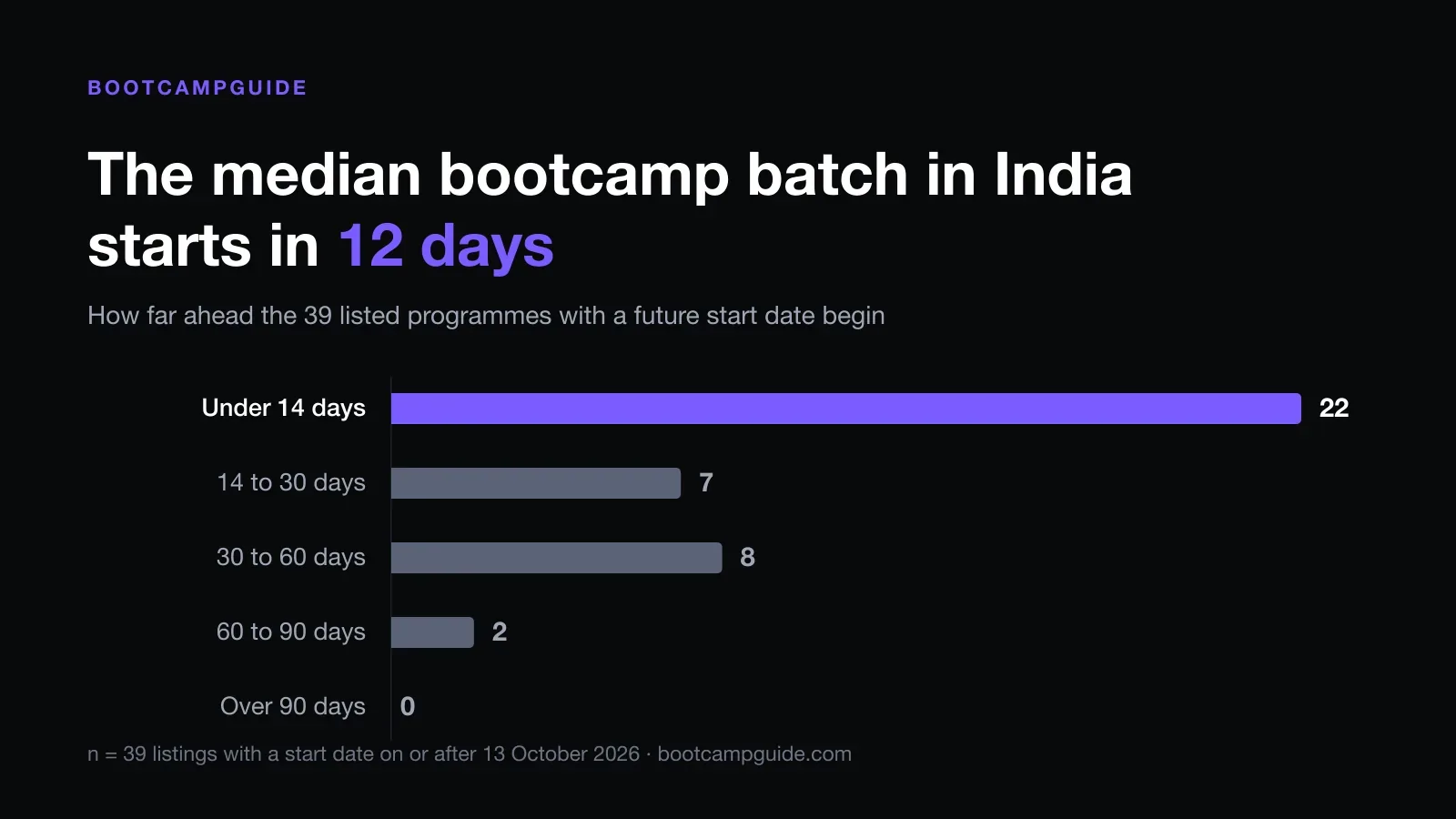
Most advice about choosing a bootcamp assumes you have months to deliberate. In India you do not. Of the 39 programmes on BootcampGuide that currently name a start date still in the future, the median batch begins in 12 days, 22 of the 39 begin inside a fortnight, and nothing visible anywhere in the market starts more than 11 weeks out.
That single fact should restructure how you go about this. By the time a batch you can actually join is on the table, you have roughly a fortnight to decide — which is not enough time to work out what you want, learn how the category is priced, and read a fee agreement properly. So the work has to be done before a start date is in view, and the decision made quickly once one is.
This guide is sequenced that way: five steps to complete while nothing is on the clock, then four for the short window you actually get. It uses figures from the 87 programmes this site lists rather than numbers imported from the American market, because the two markets are not alike. The Indian median programme runs 6 months and costs ₹79,002; Course Report puts the American average at about 14 weeks and
Why the sequence matters: there is no planning runway
Sixty of the 87 listings publish a start date. Here is how far ahead the 39 still-future batches begin, counted from 13 October 2026.
| Starts in | Programmes | Share |
|---|---|---|
| Under 14 days | 22 | 56% |
| 14 to 30 days | 7 | 18% |
| 30 to 60 days | 8 | 21% |
| 60 to 90 days | 2 | 5% |
| Over 90 days | 0 | 0% |
Median: 12 days. Longest lead time in the whole market: 75 days. Of the 60 dated listings, 43 name a date inside the current month and only two reach as far as December.
Two things follow. First, a bootcamp decision is not one you can research while a batch waits for you — the batch does not wait, and the next announced one may be a month of unstructured time away. Second, scarcity pressure in a counselling call ("the batch closes Friday") is usually accurate rather than a tactic, which is exactly what makes it dangerous: a true deadline is still a bad time to be reading a contract for the first time. Only 3 of the 87 listings publish how many seats a batch holds, so the one number that would let you judge how real the pressure is almost never appears.
The fix is unglamorous. Do steps 1 to 5 now, with no batch in view and nobody on the phone.
Phase one: the five steps to finish before a start date is in view
Step 1. Name the role, and write down the salary you are aiming at
Not "data science". Not "coding". A role as it appears in a job posting: junior data analyst, backend engineer, SDET, performance-marketing executive. The entire category is organised around roles — a bootcamp reverse-engineers one job description and spends its hours on that — so a subject-level goal cannot be matched to a programme, and cannot be used to reject one either.
Then write down a number: the salary you would accept as a first offer in that role. It is the denominator for every other decision in this guide. A ₹2.5 lakh programme and a ₹60,000 programme are not expensive and cheap in the abstract; they are expensive and cheap relative to what the role pays. If you are not yet sure the format fits your situation at all, our explainer on what a bootcamp actually is and who it suits is the step before this one.
Step 2. Check that the market serves someone at your level
This is the step most people skip, and it is the cheapest one to get right. Of the 87 programmes listed here, 54 are pitched at beginners, 31 at intermediate learners, and 2 at advanced.
So if you already write code professionally and want depth, the Indian bootcamp market is largely not built for you: you would be paying career-switcher prices for months you do not need. The honest options in that case are a single specialised short programme — 7 of the 87 finish in under three months — or a focused review of one senior-level course rather than a category search. Our write-up of Scaler's Forward Deployed Engineer programme is an example of what that assessment looks like for a programme aimed at people who can already ship.
If you are switching in from a non-technical degree or finishing one, the opposite is true. You are the reader the market is designed for, and you have 54 programmes to choose between.
Step 3. Convert the budget into rupees per month of teaching
The total fee is the wrong unit for comparison, because durations differ by more than an order of magnitude. Across the 69 listings that publish a price, totals run from ₹12,900 to ₹3,99,000 — a 31x spread that tells you almost nothing, since the bottom of it is a short single-skill intensive and the top a twelve-month live programme.
Divide by the months instead. On the 67 listings that publish both a fee and a duration, the median is ₹13,333 per month of teaching, and the spread narrows to 17x — ₹4,000 to ₹68,000 a month. That is the number to carry into every conversation, and it is the one that exposes a long programme whose headline fee looked reasonable.
| Total fee | Programmes | Share of the 69 that publish one |
|---|---|---|
| Under ₹50,000 | 13 | 19% |
| ₹50,000 to ₹1 lakh | 30 | 43% |
| ₹1 to ₹2 lakh | 19 | 28% |
| Over ₹2 lakh | 7 | 10% |
Median ₹79,002; the middle half of the market sits between ₹55,500 and ₹1,37,500. If your budget is below ₹55,000 you are shopping in the bottom quarter and should expect either a short programme or a large cohort — which is fine, as long as you know that is the trade you are making. The full distribution, institute by institute, is in our study of what coding bootcamps in India actually cost.
Step 4. Decide the payment structure before you decide the school
Do this now, not in the window, because it is the part of the decision that is genuinely hard and it narrows the shortlist sharply. There are three structures, and the choice between them is a question about your risk tolerance rather than about any school:
- Upfront. Always the cheapest total. Sixty-five of the 87 listings (75%) also offer EMI through a lender, which converts the fee into a loan with interest — cheaper than pay-after-placement in total, but it is a debt you owe whether or not the course works.
- Pay after placement, or an income share agreement. ₹0 or a small deposit now, and a fee once you earn above a threshold. It is insurance, and insurance has a premium: the totals are higher than the upfront equivalents, and the threshold, the ceiling and the clawback terms differ at every school. Our guide to pay-after-placement bootcamps works the monthly cost out at each salary level.
- Hybrid. A reduced fee during the course plus a balance afterwards. Ask for the balance in rupees at your target salary, never as a percentage.
The arithmetic genuinely reverses depending on what you earn afterwards, which is why this cannot be settled by preference. On a like-for-like comparison, Scaler Academy against Masai School shows the crossover clearly: the pay-after-placement route is cheaper below roughly ₹10 LPA and dearer above it. Between two pay-after-placement schools the terms still diverge — Masai School against AccioJob is the same comparison run inside the structure rather than across it.
Step 5. Build the shortlist from published facts only
Shortlist four to six programmes, and build the list exclusively from information a school has put in writing on its own site. The reason is arithmetic: only 47 of the 87 listings (54%) publish both a fee and a start date. Eighteen publish no fee at all, and five publish neither a fee nor a date.
A programme that publishes neither is not necessarily worse. It does mean its price is set during a sales conversation, which puts you in the position this guide is trying to keep you out of — negotiating a number you have no benchmark for, under a real deadline. Keep one or two such programmes on the list if they come recommended, but get the figure in writing before it becomes your front-runner. Our provider-by-provider check of upGrad, Great Learning, AlmaBetter and AccioJob sets out which of the four publish a fee, a start date and a refund policy, and which leave each of those to the call.
Format is the other filter worth applying here rather than later: of the 87 programmes, 57 are online and every one of those is taught live, 22 are offline and 8 are hybrid. There is no large self-paced segment in this market pretending to be a bootcamp, which is a genuine improvement on a few years ago.
Phase two: the twelve days you actually get
Step 6. Put the shortlist on one page and compare five fields
Comparison fails when the facts arrive in different formats — one school's brochure, another's counsellor, a third's landing page — because you end up comparing how well each was sold rather than what each is. Get all of them into one table with the same five columns: total fee including GST, duration in months, total live teaching hours, format, and the next start date.
Every programme on this site already lists fee, duration, format, level and upcoming batch dates on one page for exactly this reason, so you can put all 87 bootcamp courses side by side, or open a single institute's full set of programmes when you are choosing between two tracks inside one school. Total live hours is the field no listing can give you, and it is the one that matters most — it is the only way to compare a three-month programme with a nine-month one. Ask for it in step 7.
Step 7. Ask the eight questions a brochure does not answer
These are ordered by how often the answer changes a decision, and every one of them should be asked over email so you have the reply in writing.
- How many hours of live teaching in total, and how many a week? Months are a packaging unit; hours are the product. Four of the listings here sell the same syllabus at two speeds — 2.5 months on weekdays or 5 on weekends, 3 or 6, 4 or 8, 6 or 10 — which is proof that duration alone tells you nothing.
- What is the batch size, and how many mentors for that batch? A live class of 400 is a webinar with a chat window.
- What were the placement rate and the median CTC for the last three cohorts, for candidates with my background? Medians, specified by profile. A highest-package figure describes one person.
- What does placement support consist of, and for how many months after the course ends? "Lifetime access to the job portal" is not placement support.
- What is the total payable, including GST, certification or exam fees, and any post-placement balance? One number, in rupees.
- What happens if I drop out in week 2, week 8, or week 20? Ask for all three. The answer is frequently not proportional.
- May I see the full agreement before I pay anything? A refusal here is the single most informative answer in the list.
- May I speak to two graduates from the last cohort who are not on the testimonial page? Schools that are confident about outcomes arrange this; it is reasonable for them to ask the graduates first.
Be particularly sceptical of advertised placement rates. In 2024 the United States consumer regulator found that a well-known bootcamp had advertised placement rates as high as 86% while its own records showed closer to 50%, and that the income share agreements it marketed as "not a loan" were loans, carrying an average finance charge of around $4,000 (CFPB order against BloomTech). India has no equivalent regulator for this category. The verification is yours to do.
Step 8. Read the agreement for four clauses
You will not have time to read a fee agreement carefully, so read it narrowly. Four clauses account for most of the regret in this category:
- The refund schedule, week by week. Find the week after which you owe the full fee regardless. It is often earlier than the course is long.
- What triggers the post-placement fee. Not just the salary threshold — whether a job you find yourself counts, whether an internship counts, whether declining an offer the school sourced ends their obligation and starts yours.
- What the school is actually promising. "Placement assistance" and "placement guarantee" are different undertakings; a guarantee that pays out as course credit rather than a refund is a third thing again. Read the remedy, not the adjective.
- Deferral. If you cannot continue for a medical or family reason, can you move to a later batch, how many times, and at what cost? Over six to nine months this is a likelier scenario than most people allow for.
If something in the agreement contradicts what you were told on a call, resolve it in writing before you pay. The agreement is what governs.
Step 9. Commit, then protect the first four weeks
Dropping out is the main way money is lost here — more than overpaying, and far more than choosing the second-best school. The median programme is 6 months long, nearly half the market sits in the 6-to-9-month band, and most people who leave do so early, while the habit is still being built rather than once the material gets hard.
So treat the start as a scheduling problem rather than a motivational one. Block the hours in a calendar before week 1 instead of finding them each week. Tell the people you live with what the next six months look like, since evenings and weekends are exactly what a part-time programme consumes. Find one person in the cohort in week 1 — a cohort is the thing you are paying for over a video library, and it only works if you are actually in it. And complete every assessment in the first month even when the submission is optional, because the first missed deadline is what makes the second one easy.
The alternative worth taking seriously: assembling it yourself
Any honest bootcamp guide has to address this, because the material in almost every syllabus on this site is freely available. You could design your own programme — pick the role, find the free curricula, set your own deadlines, build the same portfolio — and pay nothing.
What you are buying at a median ₹13,333 a month is not the content. It is a timetable set by someone else, work reviewed by someone who has seen it done properly, a batch that notices when you go quiet, and an introduction to employers at the end. The question is therefore not "is the content worth the money" — it is not, and no school should pretend otherwise — but "what does an externally imposed deadline cost me, and do I need one?"
A reasonable rule: if you have previously finished a long self-directed course end to end, without a cohort and without a deadline, you can almost certainly assemble this yourself and should. If you have a history of abandoning them in month two — which is the common case, and not a character flaw — then the deadline is the product, and ₹13,333 a month for the thing that makes you finish is cheap against a ₹4 to ₹8 lakh first salary. Decide which of those two people you are honestly, because the entire value of the fee rests on it.
What this guide deliberately does not tell you
It does not name a best bootcamp, because the ranking changes with the role you named in step 1, the number you wrote next to it, and the payment structure you chose in step 4. A list that ignores those three inputs is a list of whoever pays the most for placement in it.
It also does not tell you that a bootcamp is the right move. Six months cannot replace a computer-science education, and the graduates who do best treat the programme as an on-ramp rather than a destination. If the role you named in step 1 mostly hires on a degree, no bootcamp fixes that, and the honest answer is to spend the ₹79,000 elsewhere.
When you are ready to compare on the same facts rather than on the same brochures, every listing here shows fee, duration, format, level and upcoming batch dates openly — all 87 courses and 16 institutes, with no sales call in between. More general questions about costs, formats and placement support are answered on our FAQ page.
Sources and how we checked
Fee, duration, format, level and batch-date figures are computed from the 87 live, non-deleted bootcamp programmes listed on BootcampGuide across 16 institutes, as at 13 October 2026. Each listing's figures are taken from the institute's own published course page and re-verified when the institute updates its listing.
Method: durations given as a range ("6 to 8 months") are taken at the midpoint; programmes publishing separate weekday and weekend timelines are counted at the weekday figure; durations stated in weekends are converted at one weekend per calendar week; the two listings sold without a fixed timetable are excluded from the duration statistics, giving n = 85. Fee statistics use the 69 listings that publish a price, and fee per month divides the published fee by the computed duration, giving n = 67. Lead-time statistics use the 39 listings whose published first batch date falls on or after 13 October 2026; listings whose published date has already passed are excluded, because a batch that has started is not one you can plan around. The seat-count figure is the 3 listings that state a batch size.
External figures: the placement-advertising case is the CFPB's 2024 order against BloomTech. The US comparison figures for programme length and cost are from Course Report's coding bootcamp guide, whose data largely predates 2021 and should be read as a market comparison rather than a current benchmark.
Institutes change fees, durations and batch dates without notice, and batch dates in particular go stale within weeks — the page for each course carries the current date. Where a listing and an institute's own page disagree, the institute's page wins, and we update the listing.
BootcampGuide has no commercial relationship with any institute named in this article.