Data Science Course Syllabus: What 16 Courses Teach | BootcampGuide
 By Prince Dewani, Contributor at BootcampGuide.
MBA (SAGE University), certified in Selenium, Cypress, Playwright, Appium and Automation Testing. Published . 16 min read. Human edited.
Topics: Data Science, Syllabus, Data Science Course, India, Original Research
By Prince Dewani, for BootcampGuide. Every module list below was read off the provider's own course page, official syllabus PDF or exam document on 26 November 2026, from an Indian connection. Module names are quoted as published; counts and sums are our own. We list courses from most of these institutes; none of them paid to appear in this article or saw it before it was published. See sources.
A data science course syllabus in India is built on Python, SQL, statistics and machine learning, which almost every course teaches, and since 2025 most courses also add generative AI. Where syllabi really differ is in the rest: how much maths you learn, whether deep learning and NLP get full modules or a single overview, and whether you learn to deploy a model or only to build one in a notebook.
We read 16 syllabi side by side: IBM's certificate on Coursera, NPTEL's IIT Madras course, ten bootcamps and four university-linked programmes. For comparison we also read the official GATE 2027 Data Science and AI paper, IIT Madras' BS degree and a university BSc Data Science syllabus. Below is what each teaches, in what order, for how long, and how to tell which syllabus fits the job you want. The whole comparison is also available as a free two-page PDF, with no sign-up needed.
The common data science course syllabus
| Subject | What it covers | In how many of the 16 syllabi |
|---|---|---|
| Python | Core Python, NumPy, pandas, Matplotlib and Seaborn, exploratory data analysis | 16 |
| Machine learning | Regression, classification, trees and ensembles, clustering, PCA, model evaluation | 16 |
| SQL | Queries, joins, subqueries, window functions, CTEs | 15 |
| Statistics and probability | Distributions, sampling, hypothesis tests, A/B tests | 13, plus 2 that cover it lightly |
| Generative AI | LLM APIs, prompt engineering, embeddings, RAG, AI agents | 12, plus 2 overviews or short modules |
| Deep learning | Neural networks, CNNs, RNNs and transformers, with TensorFlow or PyTorch | 10, plus 4 overviews or self-paced add-ons |
| Power BI or Tableau | Dashboards, data modelling, DAX or calculated fields | 9, plus 1 elective |
| Maths for machine learning | Linear algebra (vectors, matrices, eigenvalues) and calculus (derivatives, gradient descent) | 7 |
| MLOps and deployment | Git, Docker, FastAPI or Flask, MLflow, CI/CD, monitoring, cloud deployment | 7, plus 4 partial |
| Excel | Formulas, lookups, pivot tables, dashboards | 6 |
| NLP | Text preprocessing, embeddings, RNNs and transformers | 6, plus 3 electives or intros |
| Big data | Apache Spark (PySpark), Databricks, Hadoop | 4, plus 1 elective |
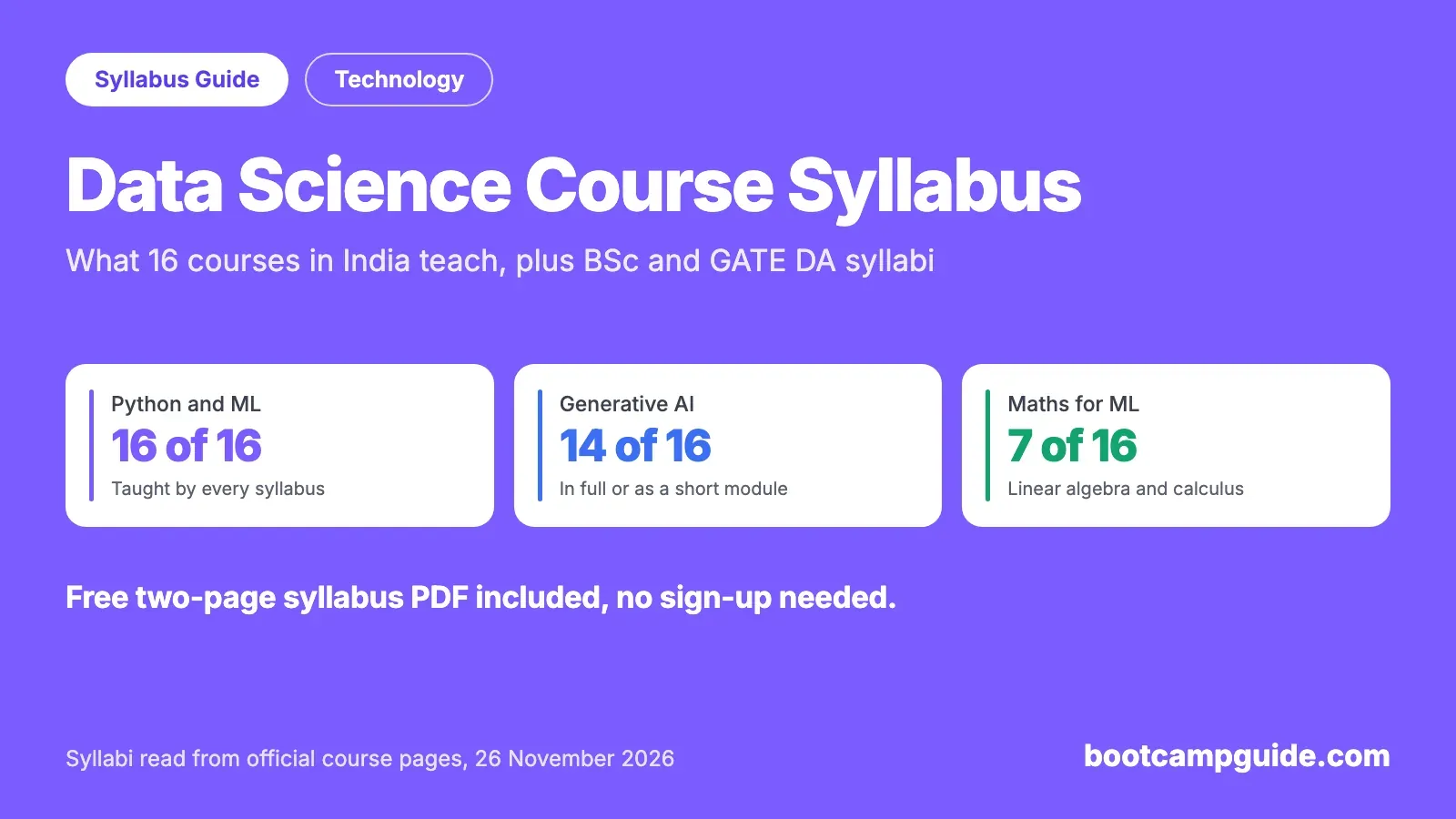
Every course except NPTEL's also has projects or a capstone. The pattern is clear: Python, SQL, statistics and machine learning are the core you cannot skip, generative AI is now in 14 of the 16 at least in part, and Hadoop, once a staple, appears in only one syllabus (ExcelR's), next to Spark.
16 data science course syllabi, side by side
"Yes" means a module in the published syllabus covers it. "Partial" means it is an elective, a self-paced add-on, or a one-module overview. A dash means the page does not list it, not that it is never mentioned in class.
| Course | Python | SQL | Excel | BI tool | Stats | Maths | ML | Deep learning | NLP | GenAI | MLOps | Spark |
|---|---|---|---|---|---|---|---|---|---|---|---|---|
| IBM Data Science (Coursera) | Yes | Yes | - | - | Partial | - | Yes | - | - | Yes | - | - |
| NPTEL Python for Data Science | Yes | - | - | - | - | - | Yes | - | - | - | - | - |
| PW Skills | Yes | Yes | Yes | - | Yes | Yes | Yes | Yes | Yes | Yes | Yes | - |
| Scaler | Yes | Yes | Yes | Yes | Yes | Yes | Yes | Yes | Partial | Yes | Yes | - |
| AlmaBetter, IIT Patna | Yes | Yes | - | - | Yes | - | Yes | Partial | - | Yes | Yes | Yes |
| AccioJob | Yes | Yes | Yes | Yes | Partial | - | Yes | Partial | - | Yes | - | - |
| ExcelR | Yes | Yes | - | Yes | Yes | Yes | Yes | Yes | Yes | Yes | Yes | Yes |
| DataMites | Yes | Yes | - | Yes | Yes | Yes | Yes | Partial | - | Partial | Partial | Yes |
| AnalytixLabs | Yes | Yes | - | Yes | Yes | - | Yes | Yes | - | Yes | Partial | - |
| Newton School | Yes | Yes | Yes | Yes | Yes | - | Yes | Yes | Yes | Yes | Yes | Partial |
| GeeksforGeeks Data Science 360 | Yes | Yes | Yes | Yes | Yes | Yes | Yes | Yes | Yes | Yes | Partial | - |
| Codebasics | Yes | Yes | - | - | Yes | - | Yes | Yes | Yes | Yes | Yes | - |
| Intellipaat, IITM Pravartak | Yes | Yes | - | Partial | Yes | Yes | Yes | Yes | - | - | - | - |
| upGrad, IIIT Bangalore | Yes | Yes | - | - | Yes | Yes | Yes | Yes | Yes | Partial | - | Yes |
| Great Learning, UT Austin | Yes | Yes | - | Yes | Yes | - | Yes | Partial | Partial | Yes | Partial | - |
| Imarticus Learning | Yes | Yes | Yes | Yes | Yes | - | Yes | Yes | Partial | Yes | Yes | - |
Three things stand out. ExcelR's 104-module syllabus is the only one that ticks every column. Intellipaat's course is called "Data Science and AI" but its published modules stop at deep learning, with no generative AI or NLP. And the IIT-linked names do not predict depth: upGrad's IIIT Bangalore programme packs the most maths into its first course, while Great Learning's UT Austin programme puts deep learning and deployment in self-paced add-ons.
Data science subjects, explained
Python for data science
Every syllabus starts here. Expect variables, data types, loops, functions and object-oriented programming, then the libraries data scientists use daily: NumPy for arrays, pandas for tables, and Matplotlib and Seaborn for charts. Most courses finish the Python block with exploratory data analysis (EDA): cleaning missing values and outliers and describing a dataset before modelling it. A few go further: PW Skills and DataMites teach APIs and FastAPI, and GeeksforGeeks teaches web scraping with Selenium.
SQL
Fifteen of 16 syllabi teach SQL, usually MySQL or PostgreSQL: SELECT, filtering, joins, GROUP BY, subqueries, and then window functions and CTEs, which interviews test heavily. NPTEL's 4-week course is the only one without it. Several add a NoSQL database, usually MongoDB (PW Skills, DataMites, GeeksforGeeks, upGrad).
Statistics and maths for data science
Statistics is near-universal: descriptive statistics, probability, distributions, the central limit theorem, confidence intervals and hypothesis tests (z, t, chi-square, ANOVA). Maths is where courses split. Seven teach linear algebra (vectors, matrices, eigenvalues) and calculus (derivatives and gradient descent), which explain how machine learning models learn. upGrad goes furthest, with "Advanced Linear Algebra and Linear Transformations" and "Multivariate Calculus" in its first course. Nine of the 16 skip maths beyond statistics, which is enough to use models but not to understand or tune them deeply.
Machine learning
All 16 teach machine learning, and the topic list is remarkably consistent: linear and logistic regression, k-nearest neighbours, decision trees, random forests, gradient boosting and XGBoost, support vector machines, naive Bayes, k-means and hierarchical clustering, and PCA, with cross-validation and evaluation metrics. Longer courses add time series forecasting (ARIMA), recommender systems, anomaly detection and model explainability with SHAP.
Deep learning, NLP and computer vision
Ten syllabi give deep learning a full module: neural networks, backpropagation, optimisers, CNNs for images, and RNNs, LSTMs and transformers for sequences, in TensorFlow or PyTorch. Four more treat it as an overview or a self-paced add-on. NLP gets a full module in six. Computer vision usually appears inside the deep learning module (CNNs, transfer learning, YOLO) rather than on its own, except at Scaler, where it is an elective.
Generative AI and AI agents
Generative AI is the newest addition to most data science syllabi. Twelve courses now teach it in full, typically LLM APIs (OpenAI, Gemini, Hugging Face), prompt engineering, embeddings and vector databases, retrieval-augmented generation (RAG) with LangChain, and AI agents with LangGraph, CrewAI or the Model Context Protocol (MCP). Some go much further: four of GeeksforGeeks' 12 sprints are on generative AI, ending with fine-tuning an LLM, and AlmaBetter's programme has been renamed around agentic AI. When you compare courses, check whether the generative AI part teaches building with LLMs, or only using ChatGPT to write code. For what these skills pay, see our AI engineer salary guide.
MLOps, deployment and cloud
Seven syllabi teach you to put a model into production, with Git, Docker, an API in FastAPI or Flask, experiment tracking with MLflow, CI/CD and monitoring, usually on AWS (SageMaker, ECS) and sometimes Azure. Four more cover it partly. This is the clearest dividing line between a course that teaches you to build models in a notebook and one that teaches you to ship them, so check this module if the job you want involves putting models into use.
Big data, Excel and BI tools
Four syllabi teach Apache Spark (ExcelR, DataMites, AlmaBetter and upGrad), and only ExcelR still teaches Hadoop. Excel and a BI tool (Power BI or Tableau) appear mainly in courses that also prepare you for data analyst roles, such as Imarticus, Newton School, AccioJob and GeeksforGeeks. If you want to start in analytics and move to data science, that overlap is useful; see our data analyst course syllabus for the analytics side.
Free and low-cost data science syllabi
IBM Data Science Professional Certificate (12 courses, about 179 hours)
Twelve self-paced courses, which Coursera estimates at "4 months at 10 hours a week"; the listed course hours add up to 179. In order: Data Science Foundations; Essential Tools (Git, Jupyter, RStudio); Data Science Methodology (CRISP-DM); Python for Data Science and AI; a Python project; Databases and SQL; Data Analysis with Python; Data Visualization with Python (Matplotlib, Seaborn, Folium, Plotly, Dash); Machine Learning with Python; the Applied Data Science Capstone; Generative AI for data science; and a career guide. It covers Python, R and SQL, but not Excel, BI tools, probability or maths, and deep learning appears only as a skill tag.
NPTEL Python for Data Science and Data Science for Engineers (IIT Madras)
NPTEL's "Python for Data Science" is a free 4-week IIT Madras course: Python with Spyder and Jupyter, NumPy, pandas, EDA, visualisation and missing data, then classification and regression case studies. Its 8-week companion, "Data Science for Engineers", is taught in R and is the most maths-heavy free option: linear algebra, probability and hypothesis tests, optimisation and gradient descent, then regression, logistic regression, k-nearest neighbours and k-means. Both are free to study, with an optional proctored exam for the certificate.
Bootcamp syllabi
PW Skills Data Science with Generative AI (8 months, 180+ hours)
Twenty modules: Excel, SQL, Python, NoSQL, Pydantic, FastAPI and Streamlit, Git, statistics, EDA, maths (linear algebra and gradients), machine learning, MLOps (MLflow, DVC, Docker, Airflow, AWS SageMaker), deep learning in PyTorch, NLP and transformers, then generative AI: vector databases, RAG, fine-tuning (PEFT, RLHF, DPO) and LLM evaluation. One of the broadest syllabi, at the lowest published price; there is no Power BI or Tableau module, and no computer vision.
Scaler Data Science and Machine Learning (12 months)
Twenty-one modules with session counts: advanced SQL, Excel and Tableau, Python, product analytics, generative AI for analytics, statistics and A/B testing, maths for AI, supervised and unsupervised machine learning, time series and recommenders, MLOps and deployment on AWS, deep learning, and a closing module on AI engineering and agentic AI. Cloud analytics on AWS, computer vision and NLP are electives. Live classes run three times a week.
AlmaBetter with IIT Patna (8 to 10 months, 300+ live hours)
Now titled "Professional Certification in Data Science and Agentic AI" with Vishlesan I-HUB, IIT Patna, it is the most engineering-oriented syllabus here: Python, SQL and APIs, then LLMs, RAG, LangGraph, MCP and multi-agent systems, then business analytics, big data (Spark, Kafka, Airflow, dbt), Azure, Docker and Kubernetes, machine learning with MLOps, and multimodal AI. It has no separate maths module, and its BI work names no specific tool.
AccioJob Data Science and AI (6 months)
Six units: Excel, SQL, Python and Power BI, all "Beginner to Advanced", then generative AI (LLMs, prompt engineering, LangChain, vector databases, RAG) and machine learning, from regression to neural networks. The page shows only the first five topics of each unit. It reads like a data analytics course extended into machine learning and generative AI, with no maths, MLOps or deep learning module.
ExcelR Data Science Course (6 months, 104 modules)
The longest published module list: statistics, Python, machine learning through boosting, deployment, unsupervised learning, time series, deep learning (ANN, RNN, LSTM, CNN in TensorFlow), NLP and LLMs, then separate blocks for core Python, Tableau, MySQL, MLOps, ChatGPT and the OpenAI API, maths for AI, big data (Spark, Databricks, Hadoop), Azure and R. It is the only syllabus that covers every subject in our table.
DataMites Certified Data Scientist (7 months, 300+ hours)
Thirteen weeks of training followed by four months of projects and internship: data science foundations, Python, statistics with essential maths, machine learning (with XGBoost, LightGBM, CatBoost and SHAP), forecasting and a FastAPI endpoint, SQL and MongoDB, Git with GitHub Actions, Spark, and Power BI. Deep learning, LLMs and RAG get a single overview module.
AnalytixLabs Data Science (6 to 8 months, 195 class hours)
Eight published modules (the page says the brochure has more): analytics fundamentals, SQL, Power BI with DAX, Python, Python for EDA, statistics, machine learning with an introduction to deep learning in Keras and TensorFlow, and generative AI with no-code agentic AI (Zapier, n8n, LangChain and CrewAI overviews). Model deployment appears as a capstone, building a Flask application.
Newton School Data Science and AI
Nine modules: spreadsheets, SQL, Power BI, Python, EDA, probability and statistics, machine learning, ML engineering and deployment (packaging, CI/CD, monitoring, serving), and deep learning covering CNNs, RNNs, transformers and generative AI. After each phase you choose an elective, including Tableau, big data and generative AI. The page shows a seven-month timeline graphic but no single duration.
GeeksforGeeks Data Science 360 (6 months, 12 sprints)
An AI toolkit module and Python and statistics prerequisites, then 12 sprints: Excel, SQL and MongoDB, Python, dashboards (Plotly Dash, Tableau, Power BI), supervised learning with maths for data science, unsupervised and ensemble learning with NLP and OpenCV, neural networks and deep learning in PyTorch, then four generative AI sprints: prompt engineering, RAG, agentic AI with LLMOps, and fine-tuning. Its capstone fine-tunes an LLM rather than a classic data science project.
Codebasics AI Engineering and Data Science Bootcamp (self-paced)
Self-paced video: Python (including "AI-native Python for agent development"), basic SQL, maths and statistics, machine learning with MLOps (MLflow, FastAPI, AWS SageMaker, data drift), deep learning in PyTorch, NLP with Hugging Face, and a long generative AI section with RAG, MCP, LangGraph, CrewAI and multi-agent design, plus two virtual internships. The core technical videos add up to about 101 hours by our count; Excel and BI tools are sold as separate courses.
IIT and university-linked course syllabi
Intellipaat with IITM Pravartak (7 months, 400 hours)
Eight modules: a Python preparatory session, SQL, Python for data science, linear algebra with advanced statistics, machine learning, supervised and unsupervised learning, deep learning in TensorFlow, and a capstone, with Power BI as an elective. Despite "AI" in the name, the published modules include no generative AI, NLP or MLOps. The 400 hours include 218 hours of self-paced learning and 50+ live sessions.
upGrad with IIIT Bangalore (6 months, 12 to 15 hours a week)
Five 5-week courses: advanced maths and programming (probability, linear algebra, multivariate calculus, OOP, SQL and NoSQL), data analysis and inferential statistics, cloud computing (AWS, GCP or Azure) with PySpark, machine learning foundations, and deep learning with CNNs, RNNs and NLP. A free 3-month programming and maths bootcamp is offered to beginners first. The page mentions MLOps and generative AI specialisations, but they are not in the listed curriculum.
Great Learning with UT Austin (12 months, 500+ hours)
Formerly the DSBA programme, now "Post Graduate Program in Data Science with Generative AI", with certificates from Texas McCombs (UT Austin) and Great Lakes: Python and EDA, generative AI for text analysis, business statistics, linear regression, classification, ensembles and tuning, unsupervised learning, SQL and Tableau, then self-paced modules on neural networks and computer vision and on business analytics, plus self-paced time series and model deployment. It is the most business-analytics-oriented of the university programmes.
Imarticus Learning Postgraduate Program (6 to 10 months, 300+ hours)
Excel, SQL, Python, statistics, machine learning (with SHAP and LIME), Power BI and Tableau, model deployment with Flask, Gradio, Streamlit and AWS SageMaker, deep learning with introductions to computer vision and NLP, and generative AI ending in a RAG chatbot, followed by a three-week project bootcamp. It runs over 6 months on weekdays or 10 months on weekends, in classrooms or live online.
BSc and BS data science degree syllabus
A degree in data science is broader and slower than a course, and much of it is computer science. Pondicherry University's BSc Data Science (Honours) syllabus for affiliated colleges, effective from 2023-24 and revised in June 2024, is a typical example under the NEP's four-year structure:
| Semester | Main subjects |
|---|---|
| 1 | Digital Logic Fundamentals; Foundations of Data Science I (probability, linear algebra, SQL); Python or R Programming |
| 2 | Problem Solving and Programming; Foundations of Data Science II (regression, machine learning basics, text analytics, Tableau); EDA or data wrangling in R |
| 3 | Object Oriented Programming; Data Structures; Probability and Statistics; data visualisation or financial analytics |
| 4 | Computer System Architecture; Design and Analysis of Algorithms; Database Management Systems; Applied Regression Analysis |
| 5 | Operating Systems; Mathematical Foundations of Computer Science; Computer Networks; Artificial Intelligence; summer internship |
| 6 | Software Engineering; Distributed Systems; Operations Research; Massive Data Management or Hadoop |
| 7 | Web Engineering; Modelling and Simulation; Big Data Analytics or Predictive Analytics; Data Mining or Text and Speech Analytics |
| 8 (Honours) | Machine Learning; Deep Learning; Time Series Analysis; Natural Language Processing; Business Analytics or Social Network Analysis |
The full machine learning, deep learning and NLP courses come only in the fourth, Honours year; a student who exits after three years gets machine learning only as part of a foundations course. Every university sets its own syllabus for BSc, BCA and BTech data science programmes, so check the semester list of the exact programme you are considering.
IIT Madras' online BS in Data Science and Applications is structured in levels instead of years. The foundation level (32 credits, 8 courses) has Mathematics for Data Science I and II, Statistics for Data Science I and II, Computational Thinking, Programming in Python and two English courses. The data science diploma adds Machine Learning Foundations, Techniques and Practice, Business Data Management and Tools in Data Science, with a choice of business analytics or "Introduction to Deep Learning and Generative AI". The degree level adds deep learning and electives such as large language models, NLP, computer vision, MLOps and big data. The full BS degree is 142 credits.
GATE Data Science and AI (DA) syllabus
The GATE DA paper, organised for 2027 by IIT Madras, tests the mathematical and computer science base of data science rather than tools. General aptitude carries 15 of the 100 marks, and the subject carries 85, across seven sections:
| Section | Main topics |
|---|---|
| 1. Probability and Statistics | Counting, probability axioms, conditional probability, Bayes' theorem, random variables, distributions (binomial, Poisson, normal, t, chi-squared), central limit theorem, confidence intervals, z, t and chi-squared tests |
| 2. Linear Algebra | Vector spaces, matrices, systems of linear equations, Gaussian elimination, eigenvalues and eigenvectors, rank, LU decomposition, singular value decomposition |
| 3. Calculus and Optimization | Functions of a single variable, limits, continuity, differentiability, Taylor series, maxima and minima |
| 4. Programming, Data Structures and Algorithms | Python, stacks, queues, linked lists, trees, hash tables, searching and sorting, graph traversals and shortest paths |
| 5. Database Management and Warehousing | ER model, relational algebra, SQL, normal forms, indexing, data transformation, data warehouse modelling |
| 6. Machine Learning | Regression, logistic regression, k-NN, naive Bayes, LDA, SVM, decision trees, bias-variance, cross-validation, multi-layer perceptrons, clustering, PCA |
| 7. AI | Informed, uninformed and adversarial search, logic, reasoning under uncertainty, inference |
Compared with a bootcamp syllabus, GATE DA has far more maths and computer science, and no generative AI, deep learning beyond feed-forward networks, cloud or BI tools. GATE publishes no official weight for each section, so section-wise mark charts you see online are estimates.
How long a data science syllabus takes
| Course | Length | Hours, as published |
|---|---|---|
| NPTEL Python for Data Science | 4 weeks | Not stated |
| IBM Data Science (Coursera) | About 4 months at 10 hours a week | About 179 (sum of course hours) |
| Codebasics | Self-paced | About 101 hours of core video (our sum) |
| PW Skills | 8 months | 180+ technical hours, plus 40+ of soft skills |
| AnalytixLabs | 6 to 8 months | 195 live class hours |
| AlmaBetter, DataMites, Imarticus | 7 to 10 months | 300+ hours each |
| Intellipaat | 7 months | 400 hours, 218 of them self-paced |
| Great Learning | 12 months | 500+ hours of content |
| Scaler | 12 months | Three live classes a week |
Is 3 months enough for data science? Enough for the foundations, not for the whole syllabus. IBM's certificate, which covers Python, SQL, basic machine learning and a capstone, takes about 179 hours, roughly four months at 10 hours a week. A full syllabus with statistics, maths, deep learning, generative AI and deployment runs 300 to 500 hours in the courses above, which is 6 to 12 months part-time.
A 6-month data science syllabus, month by month
If you are studying part-time, about 12 to 15 hours a week, this order follows how most of the 16 courses build up:
| Month | Subjects | Finish the month with |
|---|---|---|
| 1 | Python, NumPy, pandas, Git | A cleaned dataset and an exploratory analysis in a notebook |
| 2 | SQL and statistics | Window-function queries on a real database, and an A/B test write-up |
| 3 | Maths for ML and supervised learning | A regression and a classification model with proper validation |
| 4 | Unsupervised learning, ensembles, time series | A customer-segmentation or forecasting project |
| 5 | Deep learning and generative AI | A small RAG application or a fine-tuned model |
| 6 | Deployment and a capstone | One model served through an API, plus two or three portfolio projects you can explain |
Which data science syllabus fits your goal
- Data scientist at a product company: choose a syllabus with maths, deep learning and deployment, not just machine learning in notebooks. Scaler, PW Skills and ExcelR cover all three in their core syllabus.
- Machine learning or AI engineer: look for MLOps, cloud and generative AI engineering: PW Skills, AlmaBetter, Codebasics and GeeksforGeeks go furthest into RAG, agents and fine-tuning.
- Analytics first, data science later: courses that include Excel and Power BI or Tableau, such as Imarticus, Newton School, AccioJob and GeeksforGeeks, prepare you for data analyst roles on the way.
- GATE DA, an M.Tech or research: a university or IIT Madras syllabus, plus NPTEL's maths-heavy courses, fits better than a bootcamp.
- Testing the waters cheaply: start with NPTEL or IBM's certificate before paying for a full programme.
Data science course eligibility, and how hard it is
Is data science a hard course? It is demanding because it combines programming, statistics and maths. Most bootcamps above accept beginners without coding experience and teach Python from scratch. If your maths is rusty, pick a course with a maths module, or take NPTEL's "Data Science for Engineers" alongside.
Who can join? Bootcamps and online certificates generally accept graduates of any stream and working professionals; IBM's certificate needs no prior experience. Degree programmes set their own rules, so check each university's eligibility; IIT Madras' BS admits students after Class 12 through its own qualifier.
Is a data scientist an IT job? It is a technology job, but not only in IT companies. Data scientists work in banks, e-commerce, healthcare, consulting and manufacturing as well as software firms, and the syllabus above is the same whichever industry you join. For what the job pays and costs to train for, see our guides to the top data science institutes in India and data analyst salaries in India.
How to judge a data science course syllabus
- Does it cover the core: Python, SQL, statistics and machine learning? All but one of the 16 do; reject any that skips one.
- Is there maths beyond statistics? Linear algebra and calculus separate a course that teaches you to use models from one that teaches you to understand them.
- Is deep learning a full module, or one overview session? Four of the 16 treat it as an overview or a self-paced add-on.
- Does the generative AI part build things? Look for RAG, embeddings and agents, not just prompting ChatGPT.
- Will you deploy a model? Look for Git, Docker, an API and a cloud platform.
- Do the name and the modules match? Some course names promise "AI" that the module list does not deliver.
- Which modules are live, and which are self-paced add-ons or electives? Several programmes move their most advanced topics into optional self-paced content.
To compare fees, formats and batches for these courses, use the full course listing on BootcampGuide, or browse the institutes behind them.
Sources and how we checked
All pages and documents were read on 26 November 2026. Module lists come from each provider's own page or the data embedded in it; we did not submit any form to unlock a curriculum. Where a page hid part of its syllabus behind a form or a "see more" button, we say so. Coding Ninjas' Data Science Job Bootcamp shows only three weeks of its curriculum without a sign-up, and Simplilearn's data science course page now redirects to a category listing, so neither is in the comparison.
- Free and official: IBM Data Science Professional Certificate; NPTEL Python for Data Science and Data Science for Engineers; GATE 2027 DA syllabus and information brochure (revised 27 August 2026); IIT Madras BS in Data Science and Applications; Pondicherry University BSc Data Science (Honours) syllabus.
- Bootcamps: PW Skills, Scaler, AlmaBetter, AccioJob, ExcelR, DataMites, AnalytixLabs, Newton School, GeeksforGeeks, Codebasics.
- University-linked: Intellipaat with IITM Pravartak, upGrad with IIIT Bangalore, Great Learning with UT Austin, Imarticus Learning.
- Also checked: Microsoft's DP-100 study guide, which shows the Azure Data Scientist exam was retired on 1 June 2026, so we do not recommend it.